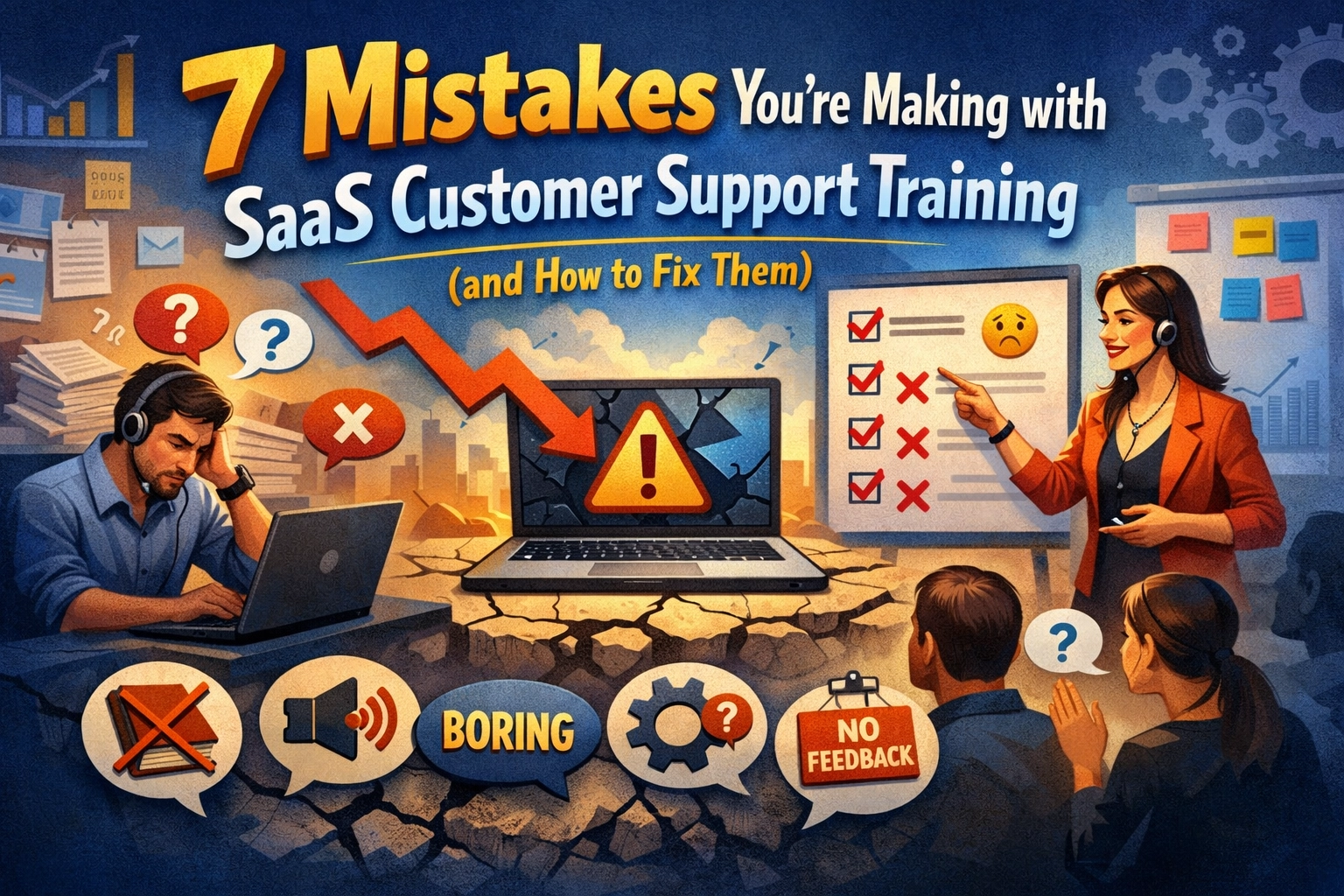
7 Mistakes You’re Making with SaaS Customer Support Training (and How to Fix Them)
You’ve hit product-market fit. Your revenue is scaling, and your customer base is growing. But behind the scenes, your support team is redlining. You’re hiring more people, yet the ticket backlog isn't shrinking, customer satisfaction is stagnant, and your churn rate is whispering warnings you can’t ignore.
Most founders try to solve this by throwing a "training program" at the problem. They buy a few seats for an online course, promote their best technician to "Lead Trainer," and hope for the best.
Six months later, they’re in the exact same spot, just $20,000 poorer.
At Malkant Group, we’ve seen this play out dozens of times. The issue isn't a lack of effort; it's a lack of architecture. If you want to scale a high-growth SaaS, you don't need a "trainer", you need a system.
Here are the seven critical mistakes you’re likely making with your SaaS customer support training and exactly how to fix them.
1. Hiring a "Trainer" Instead of a System Architect
The biggest mistake starts at the job description. Most founders hire a "trainer", someone who is great at public speaking and knows the product inside and out. While that sounds logical, it’s a trap. A trainer delivers information; a System Architect builds the infrastructure for performance.
If your training relies on a single person’s ability to "explain things well," your company is one resignation away from total knowledge loss. You need someone who can build the "Modern Service Entry Point", a system that uses digital tools and automation to handle basic tasks so your humans can focus on high-level problem solving.
The Fix: Look for instructional design expertise. Focus on building a "Service Engine" that runs on clear rules and flowcharts, not just charismatic presentations.
2. Investing in Courses That Gather Digital Dust
Passive learning is the silent killer of SaaS productivity. You’ve likely seen the data: people forget 70% of what they learn within 24 hours if they don't apply it. Buying a generic "Customer Success 101" course for your team is effectively a donation to the platform hosting it.
Your training needs to be an implementation, not just a curriculum. This is why we shifted our core offering away from memberships toward intensive 5-week or 9-week implementations. You shouldn't be watching videos; you should be building your own internal training assets every single day.

3. Relying on SMEs Who Can’t Teach
It’s a classic move: your top support agent or developer is the person "training" the new hires. The problem? Subject Matter Experts (SMEs) often suffer from the "curse of knowledge." They’ve forgotten what it’s like to not know the product. They skip steps, use jargon, and get frustrated when a new hire doesn't "just get it."
Teaching is a separate skill set from doing. To scale, you need to turn human logic into "Digital Logic."
The Fix: Use a structured framework, like our 26-session implementation, to extract knowledge from your SMEs and turn it into professional checklists and AI-assisted workflows. This ensures the "human side of modern business" remains personal without being dependent on one person's brain.
4. Ignoring the Foundations of Service & Systems
Most training starts at "how to use the software." This is a mistake. If your team doesn't understand the Foundations of Service, they will treat every ticket like a chore rather than a growth opportunity.
You have to teach your team why focusing on current customers is the best way to grow. They need to understand how to turn friction into faster results and why over-delivering on promises is a competitive advantage. Without this foundation, all the automation in the world won't save your brand reputation.
The Fix: Spend the first week of any training transition on the "Modern Service Entry Point" and "Personal Touches." Build the loyalty mindset before you build the technical skills.
5. Viewing Automation as a "Replacement" Instead of a "Force Multiplier"
Founders often see AI and automation as a way to cut headcount. This leads to robotic, frustrating customer experiences that drive users straight to your competitors.
The real mistake is not using automation as a Force Multiplier. Your training should teach your team how to use AI as a "co-pilot." They should be learning how to set up flowcharts that make every task move faster and how to use AI to handle reminders and documentation while they provide the "Human Connection."
The Fix: Implement training sessions specifically on "High-Speed Support Routines" and "Global Service Automation." Show your team how to use these tools to spend more time helping people, not less.

6. Training for Symptoms, Not Root Causes
When a customer complains, most support teams are trained to fix that specific complaint. That’s "service gap" thinking. To scale a SaaS, you need to train your team to "think like a programmer", to identify the underlying system failure that caused the complaint and fix the process so it never happens again.
If your training doesn't include project management skills and cross-departmental communication (like the handoff between Sales and Customer Success), you are just training your team to tread water.
The Fix: Incorporate sessions on "Solving Problems Before They Happen" and "Closing the Gap Between Tools and People." Train your team to look at the entire "Service Communication Loop."
7. Failing to Measure the ROI of Readiness
If you can't point to a metric and say, "This training reduced our first response time by 25%" or "This session increased our expansion revenue by 10%," then your training is a cost center, not an investment.
Founders often lack the metrics to prove training works. They see "Workplace Readiness" as a vague concept rather than a quantifiable state. You need to see real metrics that prove your training methodology is building a more durable and resilient company.
The Fix: Build a "Final Systems Build" that includes a "Delivery Framework." Use AI-driven task management to ensure every promise made during a support call is tracked and kept.

The Path to a High-Growth Support Machine
Scaling a SaaS is hard enough without a support team that feels like an anchor. Your goal shouldn't be to just "train people"; it should be to build a culture of excellence where every interaction builds trust and strategic loyalty.
This doesn't happen by accident, and it certainly doesn't happen by buying a library of pre-recorded videos. It happens through a dedicated implementation of systems, logic, and human-centric design.
Whether you choose a 5-week daily sprint or a 9-week structured implementation, the outcome must be the same: a support engine that is both professional and deeply personal, capable of handling global growth without breaking.
Are You Making These Mistakes Right Now?
You’ve posted the job description. You know you need help. But are you about to make a critical hire that sets you back six months?
Don't guess. See what a real training transformation looks like from the inside. We invite you to join our 3-Step Strategy Experience. This isn't a sales pitch: it's a behind-the-scenes look at how we diagnose these exact challenges for companies just like yours.
- Session 1: The First Conversation. Hear a real discovery call where we uncover the gaps in a scaling company’s training.
- Session 2: The Deep Dive. Listen as a senior leader discusses real struggles: from accountability gaps to handoff problems: and hear how we find the real root causes.
- Session 3: The Solution in Action. Sit in on a final panel presentation to see a complete training methodology and the metrics that prove it works.
Stop guessing and start building. Secure your spot in the 3-Step Strategy Experience here.
Build the machine. Scale the business. Over-deliver, every single time.