
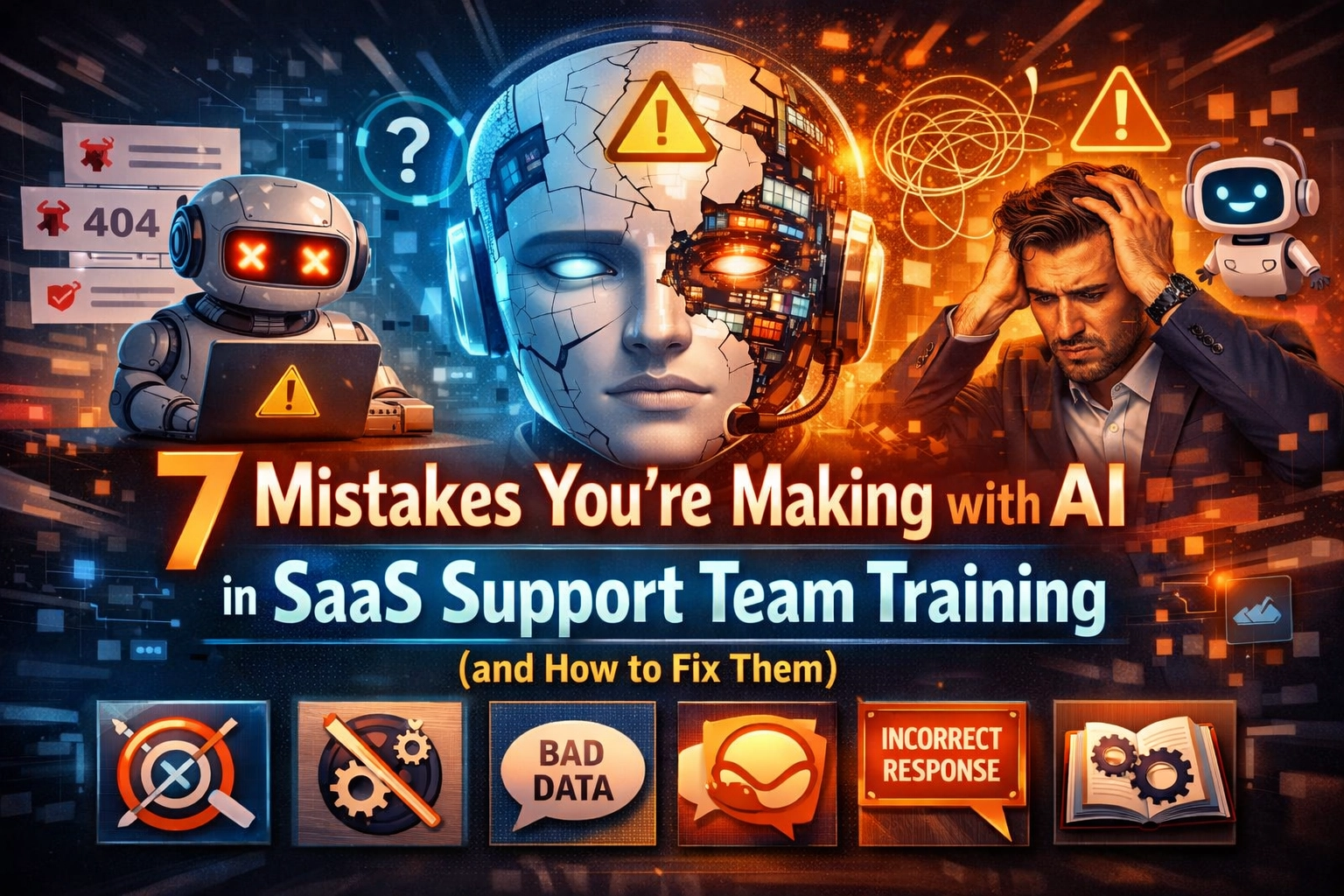
7 Mistakes You’re Making with AI in SaaS Support Team Training (and How to Fix Them)
AI is no longer a "nice-to-have" in the SaaS world; it’s the engine driving modern customer service. But here’s the reality: most companies are crashing that engine before it even leaves the garage.
We’ve seen it dozens of times at Malkant Group. A leadership team gets excited about a new LLM or chatbot, dumps their help center articles into a database, and expects the support team to suddenly become 50% more efficient. Instead, accuracy plummets, customers get frustrated, and the support agents: the very people the AI was supposed to help: stop trusting the tool entirely.
If your AI implementation feels like more work than it’s worth, you’re likely falling into one of these seven common traps. Let’s break down these mistakes and, more importantly, how you can fix them to drive real retention and mastery.
1. Treating AI Training as a "Set It and Forget It" Project
The biggest misconception in SaaS support is that AI training has a finish line. You upload your PDFs, sync your Notion pages, and call it a day, right? Wrong.
The Problem: Knowledge in a SaaS environment is fluid. Pricing tiers change, feature sets evolve every sprint, and your refund policy might look different today than it did last Tuesday. When you treat AI training as a one-time event, the system’s "knowledge" begins to decay the moment you hit save. Research shows that chatbot accuracy drops significantly when training isn't continuous.
The Fix: Implement a Living Knowledge Cycle.
Treat your AI like a new hire that needs constant coaching. Establish a weekly cadence to update the AI’s knowledge base with the latest product release notes.

2. Operating Without a "Chief AI Architect"
When everyone is responsible for "the AI," nobody is. We see many teams where the product manager handles the logic, the marketing team handles the tone, and the support leads handle the troubleshooting. The result? A disjointed experience that confuses both the bot and the customer.
The Problem: Without clear ownership, errors stay unfixed. If a customer reports that the AI gave them a wrong answer about an API integration, who fixes it? If there’s no clear owner, that error will repeat until your CSAT scores are in the basement.
The Fix: Assign an Instructional Design Lead for AI.
At Malkant Group, we advocate for a dedicated role: or at least a designated percentage of a lead's time: focused on AI "upbringing." This person is responsible for the accuracy and relevance of the outputs. They bridge the gap between technical capability and educational excellence.
3. The "Data Dump" Methodology (Quantity vs. Quality)
There is a dangerous myth that more data equals a smarter AI. When accuracy slips, the knee-joint reaction is usually to feed the AI more documents.
The Problem: Adding unstructured data without a hierarchy creates a "hallucination factory." If you have three different versions of an onboarding guide floating in your system, the AI won't know which one is the "source of truth." It will pick pieces from all of them, leading to contradictory advice that drives support tickets up instead of down.
The Solution: Command Your Data with Structure.
Before you sync a single folder, audit your content.
- Audit: Delete outdated articles.
- Structure: Use clear headers and metadata.
- Simplify: AI excels with concise, step-by-step instructions.
If you want to master how to structure these systems for real-world results, check out our insights on why your foundation needs integrated systems.
4. Failing to Build a "Human-in-the-Loop" Review Cycle
If you aren't looking at what your AI is getting wrong, you aren't training it: you’re just gambling with your brand reputation.
The Problem: Many SaaS teams operate without visibility into AI failures. They look at "deflection rates" (how many people didn't talk to a human) but ignore the "frustration rate" (how many people gave up because the AI was useless). Without a structured review loop, you miss the early warning signs of a failing system.
The Fix: Drive Improvement Through Performance Audits.
Set aside time every two weeks to review the "unanswered" or "low-confidence" queries.
- Identify the Gap: Where did the AI trip up?
- Educate the System: Feed it the correct answer immediately.
- Validate: Test the new response to ensure it doesn't break something else.

5. Training the AI but Forgetting to Train the Human Agents
This is perhaps the most critical mistake we see. Companies spend $50k on AI software but $0 on teaching their support team how to use it.
The Problem: When agents aren't trained to work with AI, they view it as a threat or a nuisance. They end up double-checking everything the AI does, which effectively doubles their workload. If the agents don't trust the tool, the ROI of your AI investment drops to zero.
The Fix: Build a "Co-pilot" Mindset.
Instructional design for SaaS support must include "AI Literacy" for the staff. Your team needs to know how to prompt the AI, when to override it, and how to report errors. They shouldn't just be "users"; they should be the AI's "managers." Mastering this shift is exactly what we teach in our readiness programs.
6. Ignoring the "Brand Voice" and Emotional Intelligence
SaaS support isn't just about giving the right answer; it's about how that answer is delivered.
The Problem: Most AI comes out of the box sounding like a robot from a 1970s sci-fi movie. It’s cold, clinical, and often dismissive. In a high-stakes support situation: like when a user’s dashboard is down during a board meeting: a cold response can lead to immediate churn.
The Fix: Tune for Tone and Empathy.
Inject your brand’s personality into the AI’s core instructions.
- Problem: The AI is too blunt.
- Solution: Update the system prompt to prioritize empathetic framing.
- Impact: A 15% increase in "Positive Sentiment" scores from customers who interacted with the bot.

7. Measuring the Wrong Metrics
If you are only measuring "Time to Close," you are missing the point of AI in training.
The Problem: High-speed wrong answers are worse than slow right ones. If your AI "resolves" a ticket in 30 seconds but the customer has to reopen it an hour later because the solution didn't work, your metrics are lying to you.
The Fix: Focus on Mastery and Retention Metrics.
Shift your focus to:
- First-Contact Resolution (FCR): Did the AI actually solve the problem?
- Agent Confidence Score: Do your support pros feel the AI is making their jobs easier?
- Net Retention Rate (NRR): Is better support leading to fewer cancellations?
The Path to Mastery
AI is a tool, but training is the craft. To build a support team that is truly "job-ready" for the 2026 landscape, you have to move past the "plug-and-play" mentality. You need a strategy that combines high-level instructional design with tactical, daily execution.
At Malkant Group, we help SaaS companies bridge this gap. We don't just teach you how to use a tool; we teach you how to command it. Whether you are looking to refine your current setup or build a world-class training program from scratch, the goal is the same: Mastery.
Don't let your AI be the reason you lose customers. Fix these seven mistakes, empower your team, and start driving the professional results your company deserves.
Ready to level up?
- Explore our Educational Resources.
- Add our latest training modules to your Wishlist.
- Take the first step toward a more efficient support team by visiting our Cart to see our current course offerings.

Unlock your potential. Build the future of SaaS support. Command your career.
