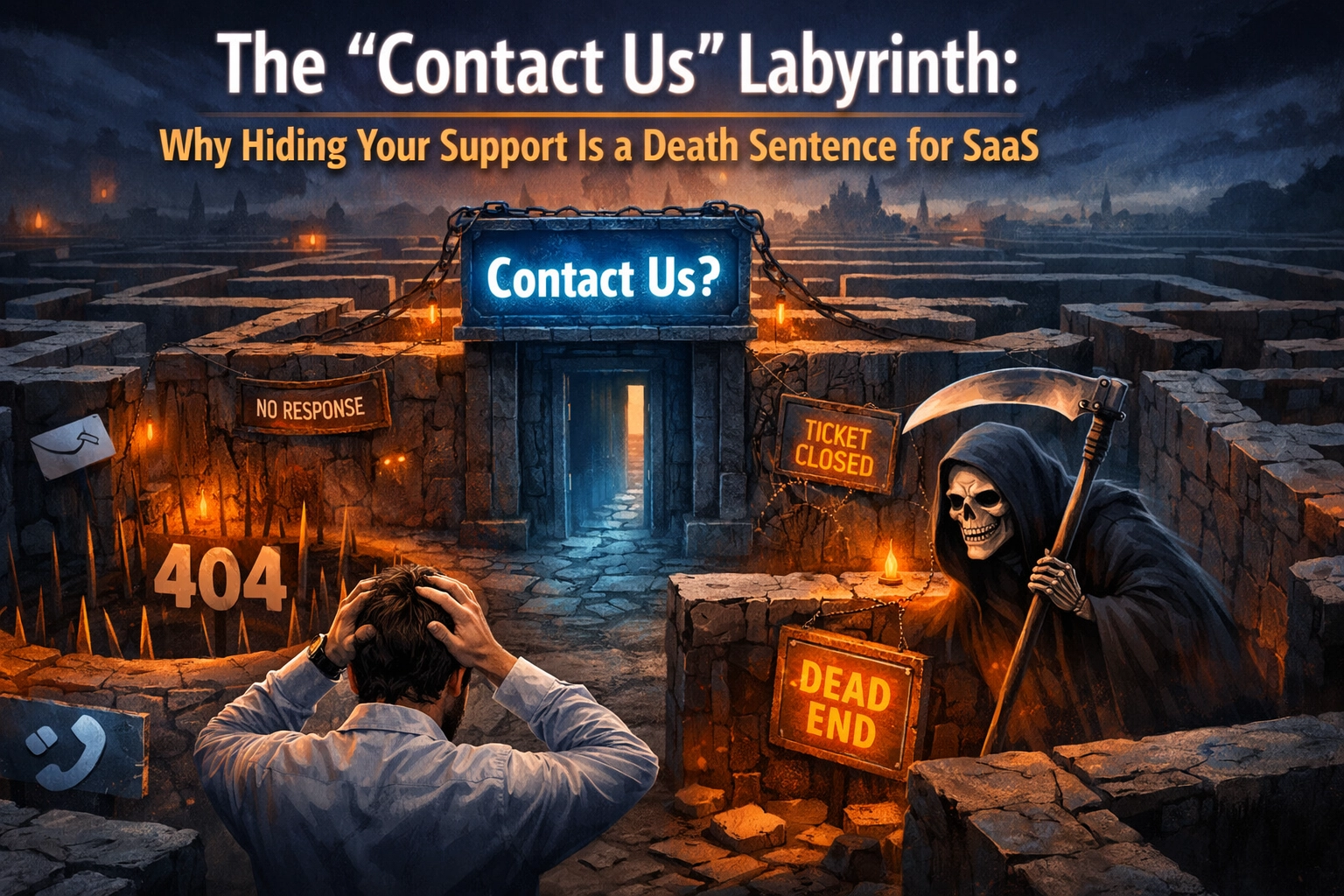
The “Contact Us” Labyrinth: Why Hiding Your Support Is a Death Sentence for SaaS
Let’s talk about Stacy. Stacy is the founder of a mid-stage SaaS platform that helps logistics companies track their fleets. Her product is solid. Her engineering team is top-tier. But Stacy has a secret fear: her inbox.
Every time Stacy sees a "Contact Us" button, she feels a pang of anxiety. To her, that button represents an open floodgate. She worries that if she makes it too easy for customers to reach out, her small team will be buried under a mountain of tickets, 2 a.m. rants, and basic "how-to" questions that are already in the manual.
So, Stacy did what many SaaS leaders do. She played "Hide the Button."
She buried the support link four clicks deep, hidden behind a "Resources" tab, tucked under a "Legal" sub-header, and eventually replaced the email address with a complex form that requires a serial number she knows most people haven't saved.
Stacy thought she was protecting her team’s time. In reality, she was signing her company’s death warrant.
At Malkant Group: Service Readiness Institute, we see this "Labyrinth" everywhere. It’s a symptom of a company that isn't Service Ready. It’s a sign that the operating system is broken, and the only way the leadership knows how to survive is by avoiding their own customers.
The Cost of the Labyrinth: Silent Churn
When you make support hard to find, you don't actually reduce the number of problems your customers have. You just reduce the number of problems you hear about.
In the SaaS world, a customer who can’t find help doesn’t just "figure it out." They get frustrated. They feel abandoned. Most importantly, they stop seeing your software as a partner in their success and start seeing it as a hurdle.
This leads to "Silent Churn." These are the customers who don't complain; they just wait for their contract to end: or worse, they cancel their month-to-month subscription without a word. They’ve already decided you aren't worth the effort.
Making support invisible kills customer confidence. If you don’t trust your own ability to support the product, why should they trust the product to run their business?

The "Fear of the Flood" Myth
The primary reason SaaS companies build these labyrinths is the "Fear of the Flood." Leaders assume that visible support equals uncontrollable ticket volume.
Here’s the reality: Visible support doesn’t create tickets. Poor systems create tickets.
If your users are constantly asking "How do I reset my password?" or "Where is the export button?", that isn't a support problem: it’s a product and documentation problem. By hiding the support link, you are simply masking a structural failure in your business.
A "Service Ready" system doesn’t hide; it guides. It uses a professional operating system to handle the "machine layer" (the repetitive, basic tasks) so that the human layer (your team) is free to handle high-value interactions.
Transitioning to a Professional Operating System
To stop hiding, you have to stop "answering emails" and start "managing a system." This is the core of what we teach in our institute membership at Malkant Group.
We break this transition down into two distinct tracks that run throughout the year:
- Track 1: The Operations Discussion. This covers 26 Core Principles of service excellence. It’s about the philosophy and the daily cadences that keep a team sharp.
- Track 2: The Efficiency Lab. This is where the heavy lifting happens. It’s a 7-Step Systems Audit designed to identify bottlenecks and automate the friction away.
If you want to move from a labyrinth to a transparent, high-confidence support model, you need to run your business through the Efficiency Lab.
The 7-Step Systems Audit: Building the Machine
The reason Stacy (our founder from earlier) was scared of the inbox was that she didn't have a filter. Everything: from "I forgot my password" to "The server is down": hit her team with the same level of urgency.
The Efficiency Lab audit fixes this. Here is how you build a system that allows you to put "Contact Us" front and center without breaking your team.
1. Identify Bottlenecks
You can't fix what you haven't measured. Look at your last 30 days of data. What are the top three reasons people reach out? If 40% of your tickets are about the same UI bug, that’s a bottleneck. If people are calling because they can’t find the billing page, that’s a bottleneck.
2. Prioritize & Automate
Once you know the bottlenecks, you automate the "machine layer." This isn't about those annoying chatbots that don't know anything. It’s about intelligent routing and self-service. If a question can be answered by a knowledge base article, the system should present that article before the ticket is created.
3. Tool Selection
Stop buying software because it has a cool landing page. Select tools that integrate with your specific workflow. Your CRM, your help desk, and your internal documentation must talk to each other.
4. SOP Development (The Foundation)
You need Standard Operating Procedures for everything. When a "Level 1" ticket comes in, there should be a zero-guesswork path for the agent to follow. This is what we call the First Pillar: Why Clear Document Protocols are Non-Negotiable. Without documented protocols, automation is impossible.

5. Gap Analysis
This is where you look at the "Human Layer." Where is the machine failing? Where do customers get stuck in a loop? Identify the gap between where your automation ends and where your human expertise begins.
6. Close the Gap
Closing the gap usually involves two things: better training for your team and better "Customer-Facing Training." If the customers are educated on how to use the platform through a scalable learning ecosystem, they won't need to click that "Contact Us" button for simple tasks.
7. Error Analysis
Finally, you need a feedback loop. Every week, look at the "errors": the tickets that took too long, the customers who left angry, or the bugs that kept reappearing. In the Service Readiness Institute, we use bi-weekly workshops to dive into these errors and refine the system.
From Fear to Confidence
When you have a 7-step system in place, the "Contact Us" button is no longer a threat. It becomes a tool for growth.
Imagine the difference in customer experience:
- Company A (The Labyrinth): The user is frustrated, spends 10 minutes looking for a link, fills out a form, and waits 3 days for a response that says "Read the manual."
- Company B (Service Ready): The user finds the "Help" button instantly. As they type their question, the system suggests the exact article they need. If that doesn't work, they are connected to a human who already has their account history and SOPs ready to solve the issue in minutes.
Company B can charge more. Company B has lower churn. Company B wins.

The Year-Long Path to Service Ready
Building this level of operational discipline isn't a weekend project. It’s not something you "sprint" through and forget. It requires a fundamental shift in how your SaaS leadership views service.
This is why our institute is built on a year-long support. We provide the daily operational frameworks and the bi-weekly workshops necessary to move through both Track 1 (the 26 Principles) and Track 2 (the 7-Step Audit).
We don't just give you a PDF and wish you luck. We help you bridge the gap between "theory" (knowing you should have better support) and "execution" (actually building the machine that handles it).
Stop Hiding. Start Leading.
If you are currently hiding your support links, you're telling your customers that your internal efficiency is more important than their success. That is a dangerous message to send in a competitive SaaS market.
You don't need a bigger support team. You need a better system. You need to move from the chaos of "answering emails" to the precision of a professional operating system.
When your "machine layer" is automated and your "human layer" is trained and supported by clear SOPs, you can put your "Contact Us" button on every single page with total confidence.
Are you ready to stop the "Contact Us" Labyrinth and build a system that scales?
Join the Malkant Group: Service Readiness Institute.
Our institute membership is designed for SaaS leaders who are ready to transition from reactive troubleshooting to proactive system management. Let’s build your Efficiency Lab together.