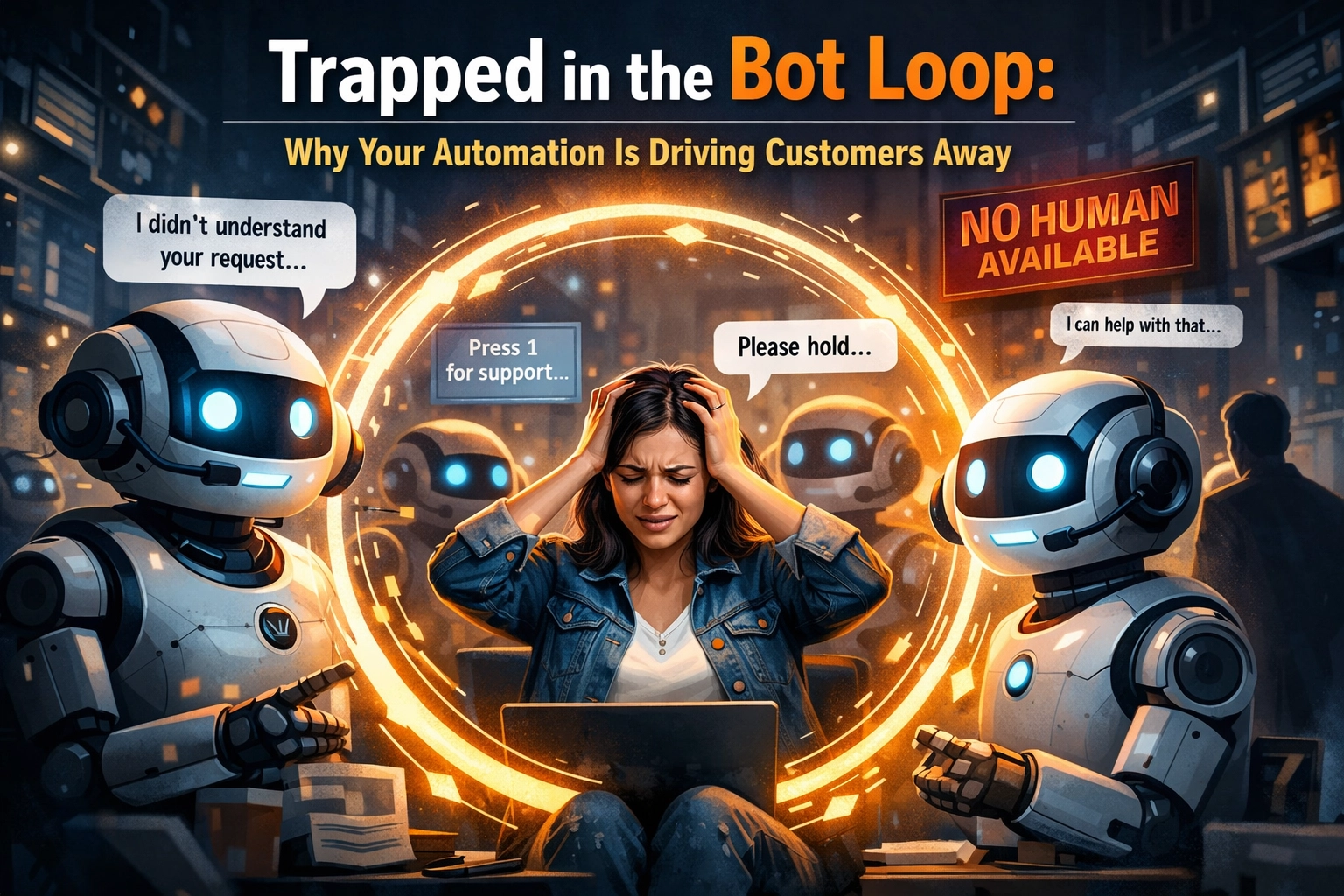
Trapped in the Bot Loop: Why Your Automation Is Driving Customers Away
We’ve all been there. You’re trying to solve a specific, slightly technical problem with a software tool you pay hundreds of dollars for every month. You open the chat bubble, hoping for a quick fix. Instead, you meet "HelpBot 3000."
You type your question. The bot suggests three articles that have nothing to do with your issue. You type "Talk to a human." The bot says, "I can help with that! Are you asking about billing, setup, or features?" You click "features." It sends you more articles. You’re trapped. This is the Bot Loop, and for a SaaS company, it is a silent killer of customer retention.
At Malkant Group: Service Readiness Institute, we see this daily. Founders and Ops leaders think they are "scaling" their support by layering in automation. In reality, they are often just building digital walls that keep customers away from the solutions they need.
Today, we’re going to look at why over-automation is backfiring and how you can design a "Service Readiness" framework that uses technology to assist: not annoy: your users.
The High Cost of the "Efficiency" Illusion
The logic behind heavy automation seems sound. If a bot can handle 70% of inquiries, your team saves time and money. On a spreadsheet, that looks like a massive win for ROI. But spreadsheets don't feel frustration.
When a SaaS customer encounters a bot loop, they don't just get annoyed; they lose trust. In the world of B2B software, trust is the primary currency. If a user feels they can’t get help when your system breaks, they start looking at your competitors.
High-friction automation leads to:
- Increased Churn: Customers leave because the perceived effort of getting help is too high.
- Brand Damage: Frustrated users vent on LinkedIn or G2, warning others about your "terrible support."
- Shadow Support Costs: Users stop using the chat and start emailing sales reps or account managers, clogging up high-value channels with basic support tasks.

Strategy: From "Automation First" to "Readiness First"
The solution isn't to delete your chatbots. The solution is to shift your mindset from "How can we automate this?" to "Is our system ready to serve this customer?"
Service Readiness means having the right resources, internal protocols, and escalations in place before the customer ever clicks that chat bubble. It’s about building a professional operating system for your service department.
A readiness-first strategy relies on three core pillars:
- Contextual Intelligence: The bot should know who the user is and what page they are on.
- The "Escape Hatch": A human should always be one click away.
- Data-Driven Feedback: If a bot fails to solve a specific problem three times, that’s not a user error: it’s a system failure that requires an SOP update.
The Execution Plan: Building Better Frameworks
To move away from the bot loop, you need a structured approach to your service operations. At the Service Readiness Institute, we teach this through our Efficiency Lab: a 7-step systems audit designed to identify these exact bottlenecks.
1. Identify the Bottlenecks
Start by looking at your data. Where do customers "drop off" in your chat flows? If 40% of people type "human" immediately after the bot speaks, your automation is a barrier, not a bridge. Use these metrics to identify which parts of your automation are actually causing friction.
2. The 3-Exchange Rule
One of the simplest ways to break the loop is to implement a hard limit on bot interactions. If the bot hasn't resolved the issue or provided a specific, helpful answer within three exchanges, it must automatically trigger a human handoff.

3. Tool Selection and SOP Development
Many SaaS companies pick a tool because it has "AI" in the name, without checking if it fits their internal workflows. Your tools must support your Standard Operating Procedures (SOPs), not the other way around.
For example, if your SOP requires a technical lead to review API errors, your bot shouldn't just say "check the docs." It should collect the error log and route it directly to the technical queue. This is where clear document protocols become non-negotiable. Without them, your bot is just guessing.
4. Close the Gap with Error Analysis
Every time a customer gets stuck in a loop, it’s an opportunity to learn. Conduct a bi-weekly Error Analysis. Review the transcripts of failed bot interactions.
- Did the bot lack the right information?
- Was the tone too robotic for a high-stress situation?
- Did the handoff to a human take too long?
By closing these gaps, you turn your automation into a high-performing member of your team rather than a source of customer pain.
Designing the Escalation Pathway
A great service framework doesn't treat escalation as a failure of automation. It treats it as a successful identification of a complex problem.
When a bot hands off to a human, the human should arrive with a full "brief." There is nothing more frustrating for a customer than repeating their account number and problem for the third time. A "Ready" system passes the context: what the user clicked, what they searched for, and what the bot tried to do: directly to the agent.
This seamless handoff is a hallmark of a professional operating system. It shows the customer that you value their time as much as your own.

Why SaaS Leaders Need a Professional Operating System
Building these frameworks isn't a one-time task. It requires a commitment to operational excellence. Most SaaS leaders are too busy putting out fires to build the fire-prevention system.
That’s why we created the Malkant Group: Service Readiness Institute. We provide the structure you need to move from reactive support to proactive service leadership.
Our institute membership is built on two primary tracks:
- Track 1: The Operations Discussion. We dive into 26 Core Principles of service excellence. These are the foundational truths that separate the "startups" from the "scale-ups."
- Track 2: The Efficiency Lab. This is where the work happens. It’s a 7-step systems audit where we help you Identify Bottlenecks, Prioritize & Automate, Select the right Tools, Develop SOPs, and perform Gap and Error Analysis.
Through bi-weekly workshops and daily operational frameworks, we bridge the gap between "knowing what to do" and "actually getting it done." We don't believe in quick fixes; we believe in building scalable learning ecosystems where your internal training supports your customer-facing reality.
Stop the Loop, Start the Relationship
Automation should be the floor of your customer service, not the ceiling. When you use it to handle the "easy" stuff: like password resets or shipping updates: you free up your humans to do what they do best: solve complex problems and build relationships.
If your customers are complaining about your "helpful" bot, listen to them. They are telling you that your operational framework is broken.
It’s time to stop guessing and start building a service department that actually serves. Design your escalations, refine your SOPs, and ensure your team is "Ready" for whatever the customer throws at them.
Are you ready to eliminate friction and build a professional operating system for your SaaS?
Join the leaders who are transforming their service departments from cost centers into growth engines.

Take the Next Step
Don't let bad automation drive your customers to the competition. Learn how to audit your systems, empower your team, and create a seamless journey for every user.